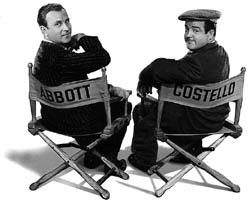
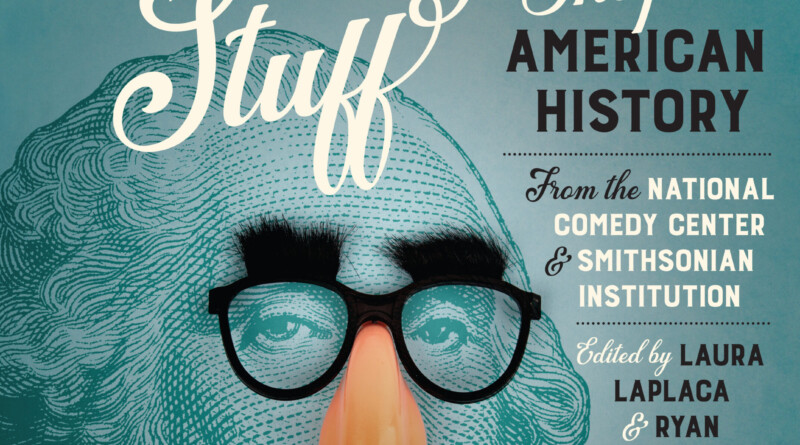
Anthology “Funny Stuff” includes Bud, Lou and Lou’s derby
The new anthology Funny Stuff: How Comedy Shaped American History, blends the collections of the National Comedy Center and Smithsonian Institution to give pop culture aficionados, history lovers and comedy nerds a new perspective on how comedy and American history, culture and identity are intertwined.
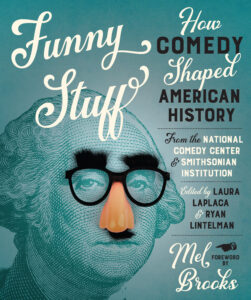 Through essays, photographs and illustrations, the book showcases various comedic forms and comedians from vaudeville to sitcoms to modern stand-up. While the odd joke or one-liner might pop up, the book eschews famous gags, monologues and routines that have appeared in previous anthologies of American humor. Chuckles are prompted by photos of genuine American heirlooms like Groucho Marx’s tailcoat; Carol Burnett’s “Went with the Wind” dress; a page from a Johnny Carson monologue; and material from Saturday Night Live, The Simpsons, The Muppet Show, In Living Color, All in the Family and I Love Lucy. (However, many images would benefit from a larger reproduction size.)
With 120 essays, Funny Stuff is an ambitious attempt to document comedy’s historical significance, but will probably be read in small bites. Randomly open to any page and you will no doubt find an essay or image that catches your interest, although some essays are overly academic and others are superficial and fail to make their case.
In a work like this, the reader cannot help but equate the length of an essay to how important the editors view a particular comedian or comedic form. The essays on Abbott and Costello and Laurel and Hardy are dwarfed by a nearby tract on comedienne Minnie Pearl that is three times longer. (Even Stiller and Meara have a lengthier entry than Bud and Lou.) Martin and Lewis warranted a brief essay, yet somehow the Three Stooges did not.
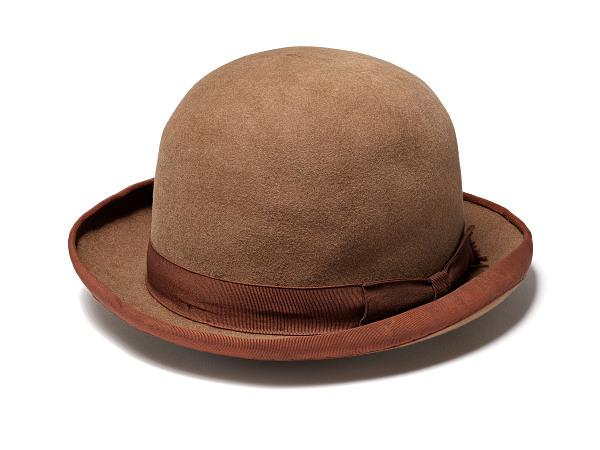
Though fans will find it too short, the essay on Abbott and Costello is accurate. But, in keeping with the book’s mission, it could have related the boys’ confused wordplay routines to the immigrant experience in America, and better explored why the duo resonated so strongly with Americans during World War II. At the very least it should have noted Bud and Lou’s inspiration for another cultural touchstone, Seinfeld, which is profiled at length later in the book. Two images illustrate the boys’ essay: a page from a 1947 radio script with “Who’s on First?” and Costello’s iconic derby, which his daughters donated to the Smithsonian in 2005. Unfortunately, the caption for the derby states that he wore it on the Colgate Comedy Hour in “the 1950s and ‘60s.” The Colgate series ended in 1955 and Lou died in 1959.
The essay also makes the rookie mistake of using vaudeville and burlesque interchangeably, although the two forms are as different as Saturday Night Live and The Ed Sullivan Show. As A&C fans know, the boys were, first and foremost, burlesque comedians, and the essay properly credits them with preserving classic sketches, however the material is ascribed to vaudeville. While these routines did sometimes turn up in vaudeville, they are most associated with burlesque.
On a broader note, the omission of a dedicated essay on burlesque comedy is particularly disappointing given the inclusion of essays on less significant topics like “prop comedy” and “Midwestern Comedy.” (One suspects that the Midwest and Minnie Pearl entries are there to achieve some cultural balance in polarized times.) The Abbott and Costello essay could have served as an excellent platform to delve into burlesque, a uniquely American art form which originated from 19th-century entertainments such as minstrel shows, honky tonks, and medicine shows. Burlesque comedy not only satirized societal norms and issues but also provided a humorous yet insightful reflection of American life. Additionally, burlesque comedians leveraged these sketches for improvisation, much like musicians in another distinctly American art form, jazz, do with popular tunes to create new interpretations. In a book aiming to examine the relationship between humor and our national identity and culture, this represents a significant missed opportunity.
However, Funny Stuff is a highly commendable effort that will appeal to comedy aficionados and general readers. Its strength lies in the impressive breadth of its coverage and the presentation of historical artifacts. It struggles with uneven essays, omissions, inconsistent formatting and abrupt transitions, but encourages readers to appreciate the historical importance of humor in shaping American identity. It is a significant addition to the bookshelf of anyone interested in the intersection of culture and history.